
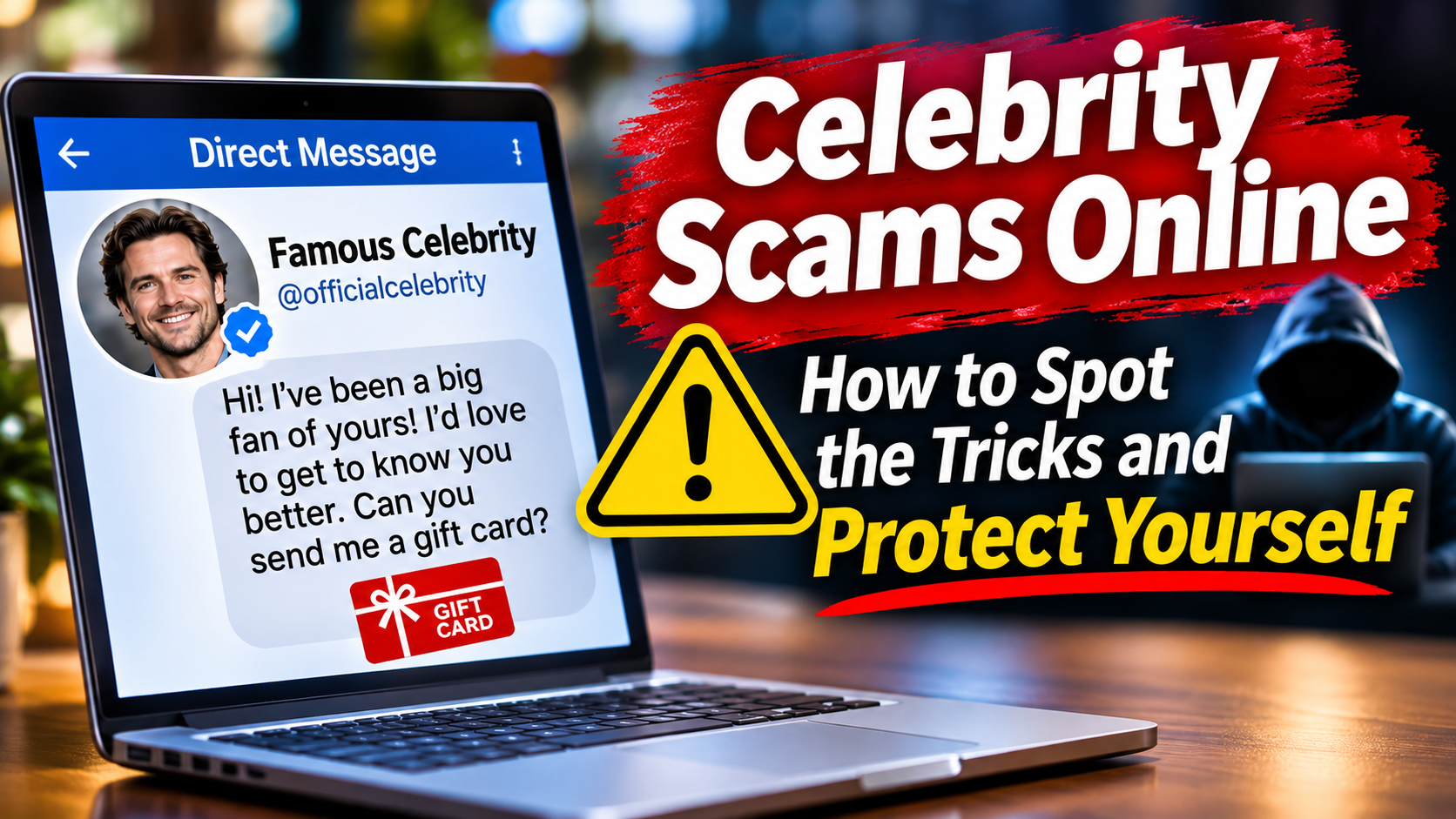
Just because you recognize the face doesn’t mean you can trust the message.
We live in a world where celebrities are everywhere on the internet. From Facebook and Instagram to TikTok, YouTube, and other social media platforms, famous actors, musicians, athletes, and television personalities are constantly appearing in our feeds.
But here’s something everyone needs to understand: That celebrity contacting you online may not be a celebrity at all.
Internet scammers are increasingly using famous names, stolen photographs, fake social media accounts, and artificial intelligence (AI) to trick unsuspecting people into giving away money, personal information, and sometimes even their identities.
These scams are becoming more sophisticated, and anyone who uses the internet needs to recognize the warning signs.
When Your Favorite Celebrity Suddenly Wants to Be Your Friend
Imagine opening Facebook and discovering a friend request from your favorite actor, musician, or television personality.
At first, you might be excited. The profile contains familiar photographs, posts about upcoming appearances, and hundreds or thousands of followers. Everything looks legitimate.
Then comes a private message.
“Thank you for being such a loyal fan. I wanted to personally reach out and get to know you.”
It sounds flattering, doesn’t it?
That’s exactly what the scammer wants.
The conversation may begin innocently enough. The person asks about your day, your family, or how long you’ve been a fan. Over time, the messages become more personal.
Eventually, the scammer may claim to have developed romantic feelings, offer you exclusive access to the celebrity, or ask for financial assistance.
Remember: A famous person you have never met is extremely unlikely to randomly contact you through social media and ask for money or personal favors.
The Most Common Celebrity Scams
Celebrity impersonation scams come in several forms. Understanding how they operate is one of the best ways to protect yourself.
- The Celebrity Romance Scam
A scammer creates a fake celebrity profile and begins communicating with fans. Over time, the scammer develops what appears to be a personal or romantic relationship.
Eventually, there’s an emergency. Perhaps the celebrity claims their bank accounts are frozen, their management company is withholding money, or they need financial assistance to arrange a private meeting.
The scammer may request gift cards, wire transfers, cryptocurrency, or payments through money-transfer applications.
Think about it. Why would a wealthy, internationally recognized celebrity need financial assistance from someone they met online?
- The Exclusive Fan Club Scam
Another common trick involves invitations to join a supposedly exclusive celebrity fan club.
The scammer promises personal conversations, backstage passes, private video calls, or opportunities to meet the celebrity.
There’s just one catch: You must first pay a membership fee.
While legitimate fan clubs and paid celebrity experiences do exist, scammers frequently create fraudulent versions designed to collect money and personal information.
Never assume an offer is legitimate simply because it features a celebrity’s name or photograph.
- The Celebrity Giveaway Scam
You’ve probably seen posts claiming that a famous person is giving away thousands of dollars, expensive vehicles, or other valuable prizes.
The message might say:
“Congratulations! You’ve been selected as one of my lucky followers. Send me a private message to claim your prize!”
Once you respond, the scammer tells you that you must pay a processing fee, shipping charge, or tax before receiving your winnings.
The prize never arrives.
A legitimate prize should not require you to send money to an unknown person through a private social media conversation.
- Fake Celebrity Investments and Endorsements
This type of scam is especially concerning because artificial intelligence is making it easier to create convincing advertisements.
Scammers use celebrity photographs, manipulated videos, and fabricated endorsements to promote questionable investments, cryptocurrency opportunities, miracle health products, and other fraudulent schemes.
You might see a video of a well-known television personality apparently recommending an investment that guarantees enormous returns.
But the celebrity may never have said those words.
The video could be an AI-generated deepfake designed to deceive viewers.
Remember that a celebrity’s face appearing in an advertisement does not prove that the celebrity endorsed the product or investment.
Artificial Intelligence Has Changed the Game
Years ago, many internet scams were relatively easy to identify. Poor grammar, obviously fake photographs, and suspicious email addresses were common warning signs.
Today, AI technology allows criminals to produce convincing photographs, realistic voice recordings, and videos that appear to show actual celebrities speaking.
Scammers can even imitate someone’s voice or create a realistic video conversation.
That means seeing someone’s face or hearing their voice is no longer sufficient proof that you’re communicating with the real person.
The technology itself isn’t necessarily the problem. Artificial intelligence has many legitimate and beneficial applications.
The problem is how dishonest people choose to use it.
As AI continues to improve, internet users must become more cautious about trusting digital content.
Warning Signs You Should Never Ignore
Regardless of which celebrity is supposedly contacting you, certain warning signs should immediately raise concerns.
- Requests for money: Someone claiming to be a celebrity asks for gift cards, cryptocurrency, wire transfers, or other payments.
- Requests for secrecy: You’re told not to discuss the conversation with friends or family.
- Pressure to act immediately: The person insists that you must respond or send money before an opportunity disappears.
- Promises of a personal relationship: A celebrity you’ve never met suddenly expresses romantic interest.
- Requests to move conversations: You’re encouraged to leave the original social media platform and communicate through another messaging application.
- Suspicious accounts: The profile has limited history, unusual usernames, inconsistent information, or photographs copied from other sources.
- Requests for personal information: Someone asks for passwords, banking details, identification documents, or verification codes.
Any one of these warning signs should be enough to make you stop and investigate.
Even Verified Accounts Require Caution
Some people believe that a verification badge automatically means an account can be trusted.
Unfortunately, that’s not always true.
Verification procedures vary among social media platforms, and some offer paid verification services. Legitimate accounts can also be compromised by criminals.
A verification badge is not a guarantee that a particular message, offer, or financial request is genuine.
Never rely on a badge alone when deciding whether to send money or disclose personal information.
How to Protect Yourself
Fortunately, there are several practical steps you can take to reduce your risk of becoming a victim.
First, verify the account independently. Visit the celebrity’s official website and follow links to their legitimate social media profiles. Don’t rely on links supplied by the person contacting you.
Second, never send money to someone you know only through the internet. This is especially important when the person claims to be famous or promises a romantic relationship, exclusive opportunity, or financial reward.
Third, protect your personal information. Never provide passwords, financial information, Social Security numbers, or account verification codes to someone contacting you unexpectedly.
Fourth, research suspicious offers. Search the internet for the celebrity’s name along with words such as “scam,” “fake account,” or “fraud.” You may discover that other people have received identical messages.
Fifth, talk to someone you trust. Scammers often depend on secrecy and emotional manipulation. A second opinion can help identify warning signs you might overlook.
Finally, report suspicious accounts to the social media platform and block further contact.
What If You’ve Already Been Scammed?
If you’ve already sent money or shared sensitive information, act quickly.
Contact your bank, credit card company, or payment provider immediately. Explain what happened and ask whether the transaction can be stopped or reversed.
Change any compromised passwords, enable multifactor authentication, and review your accounts for suspicious activity.
If you’ve provided sensitive identifying information, visit IdentityTheft.gov for guidance on protecting your identity.
You can also report fraud to the Federal Trade Commission at ReportFraud.ftc.gov.
Don’t allow embarrassment to prevent you from reporting the incident. These criminals deliberately use psychological manipulation and increasingly sophisticated technology to deceive people.
Don’t Confuse Being a Fan With Having a Personal Relationship
There’s nothing wrong with admiring a celebrity, following their career, attending concerts, watching their movies, or participating in legitimate fan communities.
The danger begins when someone exploits that admiration to create a false sense of personal connection.
Scammers understand that people may become excited when someone famous appears to notice them. They use that excitement to lower skepticism and build trust.
Sometimes the scam unfolds over days. Other times, criminals spend weeks or months developing a relationship before asking for money.
The longer the relationship continues, the harder it may become for someone to accept that the person they’ve been communicating with isn’t real.
That’s why recognizing these tactics early is so important.
A Final Thought: Think Before You Trust
The internet has made it easier than ever to connect with people around the world. Unfortunately, it has also given criminals powerful new ways to deceive us.
Celebrity scams are a reminder that appearances can be misleading, especially in a world of AI-generated content, manipulated videos, and fraudulent social media accounts.
The next time your favorite actor, musician, or television personality suddenly sends you a personal message, ask yourself one simple question:
“Why would this celebrity be contacting me personally?”
If the conversation eventually involves money, secrecy, personal information, or promises that sound too good to be true, there’s a good chance you’re dealing with a scammer.
Being cautious doesn’t mean you have to stop enjoying social media. It means recognizing that trust should be earned, not automatically granted because someone uses a familiar name or face.
Stay informed. Stay skeptical. And most importantly, stay safe online.
Horner Consulting & Publishing LLC has been helping businesses and individuals navigate technology since 1999. We believe that understanding technology, recognizing online threats, and practicing good cybersecurity habits are essential to making the internet a safer place for everyone.