
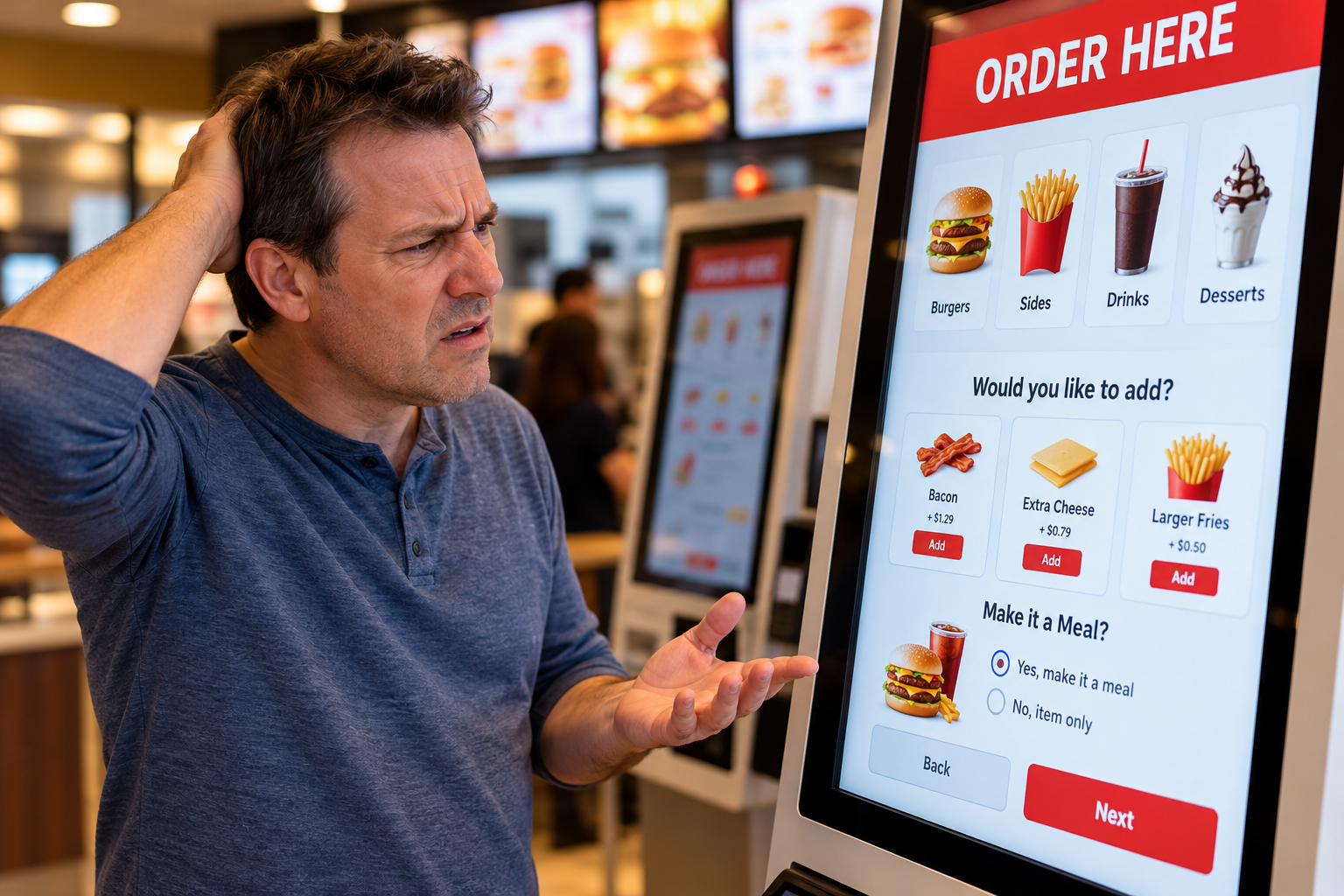
Technology is supposed to make our lives easier. So why does ordering a cheeseburger now feel like operating a computer at the DMV?
Remember when you could walk into a fast-food restaurant, approach the counter, tell someone what you wanted, pay for your food, and be on your way? It was simple, efficient, and usually involved an actual conversation with another human being.
Those days seem to be disappearing.
Today, more fast-food restaurants are replacing traditional counter ordering with touchscreen kiosks. Instead of being greeted by an employee asking, “Can I take your order?” you’re greeted by a glowing screen demanding that you navigate through a maze of menus, options, upgrades, and endless questions.
And frankly, it’s becoming a pain in the neck.
I Just Want a Burger, Not a Computer Science Degree
Let’s say you walk into your favorite fast-food restaurant because you’re hungry and want a simple cheeseburger, fries, and a drink.
Sounds easy, right?
Not anymore.
First, you have to figure out how to start the ordering process. Then you’re presented with multiple screens of menu categories, promotional offers, meal combinations, and customization options.
You finally locate the cheeseburger, only to be asked whether you want to make it a meal, add bacon, change the cheese, remove the pickles, upgrade the fries, or add another item.
Then comes the drink selection, followed by more questions.
By the time you’re finished, you’ve tapped the screen fifteen times just to order something you could have told a cashier in fifteen seconds.
And don’t accidentally hit the wrong button. You might find yourself starting over or desperately searching for a way to correct your order.
Whatever happened to simply saying, “I’ll have a number three with a Coke”?
Technology Isn’t Always an Improvement
As someone who has worked with computers and technology for years, I appreciate innovation. I understand why businesses invest in automation, and I recognize that technology can improve efficiency when it’s implemented properly.
But there’s a difference between technology that makes life easier and technology that simply transfers work from employees to customers.
Fast-food kiosks often seem to fall into the second category.
Restaurants may benefit from reduced labor demands, standardized ordering, and opportunities to encourage additional purchases. But what exactly is the customer getting in return?
Are we receiving faster service? Not necessarily.
Are we getting lower prices because we’re doing part of the work ourselves? I certainly haven’t noticed that.
Are we enjoying a better customer experience? That depends on how much you enjoy arguing with a touchscreen.
Technology should solve problems, not create new ones.
The Endless Upselling Is Exhausting
One of my biggest complaints about these kiosks is the constant attempt to sell me something else.
Want to add a dessert?
Would you like to upgrade your drink?
How about another sandwich?
Would you like to try our latest special?
No, thank you. I just want the food I came here to buy.
I understand that restaurants want to increase sales. That’s business. But there’s something particularly irritating about having to decline multiple offers just to complete a simple transaction.
At least with a human cashier, you can politely say “No, thanks,” and move on.
With a kiosk, you’re at the mercy of whoever designed the software.
What About Customers Who Aren’t Comfortable With Technology?
Here’s another issue that deserves more attention.
Not everyone is comfortable using touchscreen technology.
Some older customers may struggle with unfamiliar interfaces, small text, or complicated menus. People with vision problems, limited dexterity, or other disabilities may encounter additional challenges.
Even people who use smartphones and computers every day can become frustrated with poorly designed kiosks.
And what happens when someone needs assistance?
They have to find an employee to help them operate the machine that was supposedly installed to make ordering easier.
There’s something almost comical about that.
Restaurants should be welcoming places where anyone can order a meal without feeling confused, embarrassed, or pressured to learn a new technology.
And Then There’s the Cleanliness Question
Think about how many people touch those kiosk screens throughout the day.
Now think about how many of those same people immediately sit down and eat french fries or a hamburger with their hands.
Not exactly an appetizing thought.
Touchscreens are shared surfaces, and unless they’re cleaned regularly, they can accumulate dirt and germs just like door handles, payment terminals, and other frequently touched objects.
At least when ordering at a counter, you don’t necessarily have to spend several minutes poking at a screen that hundreds of other customers may have touched.
Where Did Customer Service Go?
Perhaps the most disappointing part of this trend is the gradual disappearance of personal interaction.
Fast-food restaurants were never known for elaborate table service, but there was something pleasant about being greeted by a friendly employee.
A simple smile, a quick conversation, or someone remembering your usual order can make a difference.
Now, in some locations, customers are directed toward kiosks while employees concentrate on preparing food and handling other tasks.
I’m not blaming the employees. They’re doing the jobs they’ve been assigned.
But I do question whether businesses are losing sight of something important: Customer service involves more than completing a transaction.
Sometimes people just want to deal with another person.
Are Kiosks Really Faster?
Restaurant operators frequently promote kiosks as a way to improve speed and accuracy.
And under the right circumstances, they can.
For customers who know exactly how the system works, ordering through a kiosk might be convenient. Some people enjoy taking their time, customizing meals, and avoiding a line at the counter.
That’s perfectly reasonable.
But when a customer has to navigate a confusing interface, search through multiple menus, and respond to endless prompts, the supposed time savings can disappear quickly.
And even after completing the order, you still have to wait for the kitchen to prepare the food.
A faster ordering process doesn’t automatically mean faster service.
Give Customers a Choice
I’m not suggesting that fast-food restaurants should eliminate kiosks entirely.
For some customers, they’re useful. For others, they’re an unnecessary frustration.
The solution seems pretty obvious.
Give people a choice.
Keep the kiosks for customers who prefer them, but maintain a staffed counter for those who would rather order the traditional way.
Make sure employees are available to help customers, and design kiosk software that doesn’t require a dozen screens to purchase a simple meal.
Most importantly, stop assuming that every technological advancement automatically represents an improvement.
Sometimes the best solution is also the simplest.
Final Thoughts: I Came for Lunch, not a Software Tutorial
Fast-food restaurants built their reputations on convenience, affordability, and speed.
Customers could walk in, place an order, and get a reasonably quick meal without much effort.
Today, the industry seems increasingly determined to make customers participate in the ordering process through self-service technology.
I understand the business reasons behind the change. But I also believe companies should remember why customers visit fast-food restaurants in the first place.
We want something quick, easy, and convenient.
We don’t want to navigate a touchscreen obstacle course just to buy lunch.
And after spending years working with computers, websites, and technology, I find it particularly ironic that one of the things I increasingly appreciate is a restaurant where I can simply walk up to a counter and talk to another human being.
Sometimes progress isn’t about adding another screen. Sometimes it’s about remembering what worked in the first place.
What do you think?
Do you like ordering from fast-food kiosks, or would you rather deal with a real person at the counter? Have you ever walked out of a restaurant because ordering was too complicated?
Share your thoughts. I’d be interested to hear whether I’m alone in this frustration or whether others are getting tired of doing the restaurant’s work for them.