
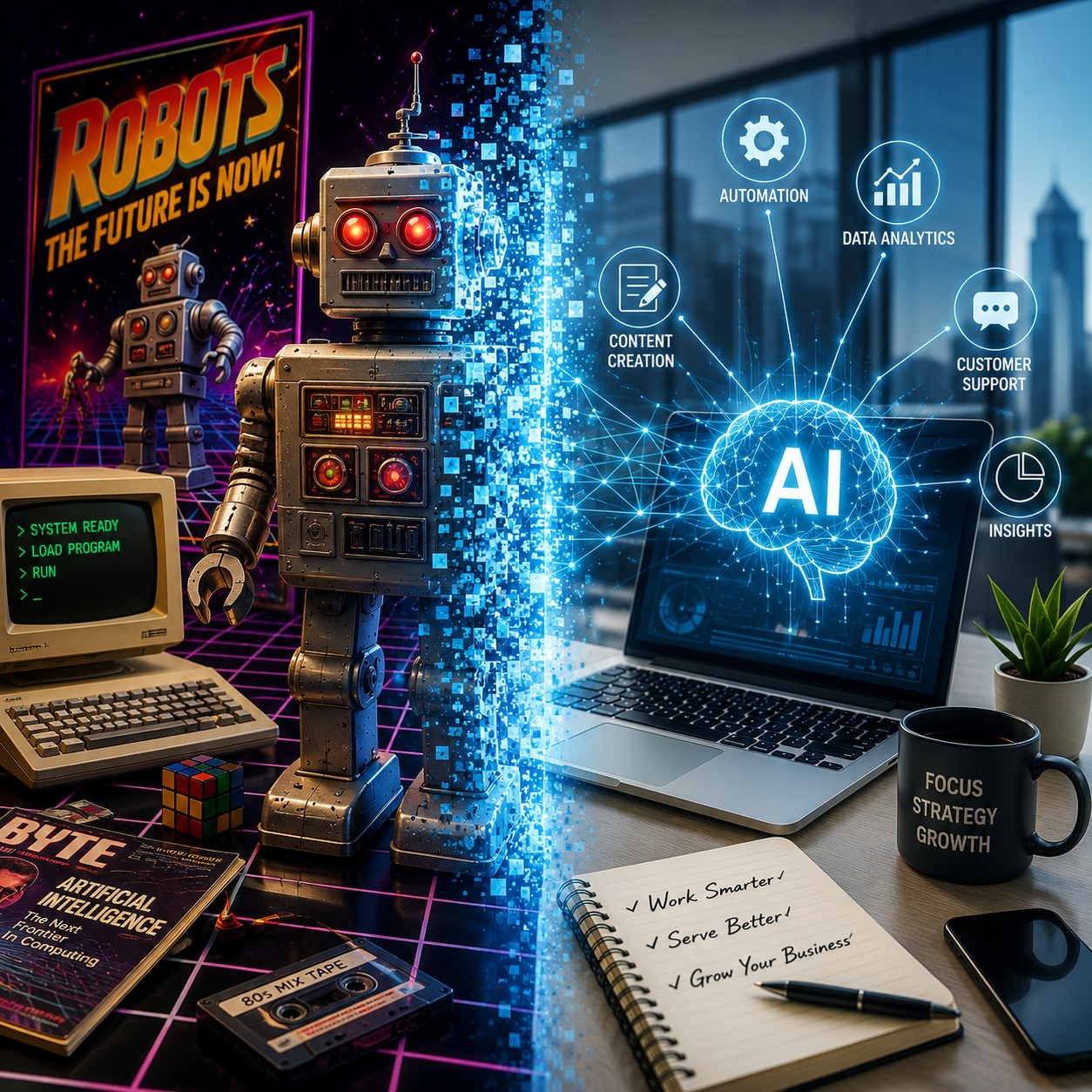
If you grew up in the 1980s, you probably remember when robots seemed destined to become part of everyday life.
Movies, television shows, cartoons, toys, and magazines were filled with intelligent machines. Some were helpful companions. Others could answer questions, solve problems, perform work, and make decisions. And, naturally, science fiction gave us a few that wanted to take over the world.
We were repeatedly told that robots were coming.
The interesting thing is that they did arrive—just not quite the way we expected.
Instead of a metal robot walking through the office door, we got artificial intelligence running on computers, smartphones, websites, cloud services, and business applications.
The robots we imagined in the 1980s have essentially become today’s AI.
For small-business owners, that’s more than an interesting observation about technology. Artificial intelligence is rapidly becoming another business tool—one that can help companies improve productivity, automate routine tasks, strengthen marketing, serve customers, and make better use of their existing resources.
In the 1980s, Artificial Intelligence Needed a Robot
The popular vision of artificial intelligence during the 1980s usually involved a physical machine.
If a computer could think, it needed a face. If it could talk, it needed a mouth. If it could help around the office or home, apparently it also needed arms, legs, flashing lights, and futuristic electronic sound effects.
It made sense at the time.
Personal computers were only beginning to become commonplace. The idea that ordinary people would someday carry powerful computers in their pockets would have sounded extraordinary enough.
The idea that we would talk to those computers in everyday language and ask them to write, research, analyze information, create images, generate computer code, or help operate a business would have sounded like science fiction.
So when we imagined artificial intelligence, we gave it a body.
We called it a robot.
Today, we’ve largely separated the intelligence from the machine.
The result is AI.
We Were Focused on the Robot Instead of the Intelligence
Looking back, the most important characteristic of the fictional robots of the 1980s wasn’t their mechanical bodies.
It was what we expected them to do.
We imagined machines capable of understanding instructions, answering questions, remembering information, solving problems, performing repetitive work, analyzing situations, operating equipment, and helping people make decisions.
Those expectations sound remarkably similar to today’s artificial intelligence.
Ask a modern AI system a question and it can respond conversationally. Give it a document and it can summarize or analyze it. Provide information about a business problem and it can suggest possible approaches.
AI can help draft correspondence, create marketing concepts, organize information, develop website content, explain technical subjects, assist with computer programming, analyze data, and perform many other knowledge-based tasks.
The physical robot may be missing.
Much of the capability we expected from it isn’t.
Today’s Business Robot Is Software
For business owners, this is where the comparison becomes especially important.
The robot that was supposed to help operate the office didn’t arrive as a machine rolling down the hallway.
It arrived as software.
Artificial intelligence for small business can potentially assist with tasks throughout an organization.
A business might use AI to help:
- Draft emails, letters, proposals, and other business communications.
- Develop ideas for blog articles and website content.
- Research markets, competitors, products, and industries.
- Summarize lengthy reports, meeting notes, or documents.
- Analyze spreadsheets and business information.
- Brainstorm advertising and marketing campaigns.
- Generate social-media content ideas.
- Improve existing website copy.
- Create frequently asked questions and customer-support materials.
- Assist with computer programming and troubleshooting.
- Organize information and internal documentation.
- Automate portions of repetitive administrative processes.
None of these examples requires a humanoid robot.
They require software, good information, appropriate tools, and someone who understands how to use them effectively.
That’s an important development for small businesses.
AI Is Giving Small Businesses Access to Bigger-Business Capabilities
Technology has repeatedly made capabilities that were once expensive available to smaller organizations.
Websites are a good example.
There was a time when establishing a significant online presence required considerable technical resources and expense. Today, even a very small company can maintain a professional website, sell products online, communicate with customers around the world, and operate sophisticated cloud-based business systems.
AI for small business could represent another step in that progression.
A small company may not have a dedicated marketing department, research staff, copywriter, data analyst, programmer, or administrative assistant available for every project.
AI doesn’t necessarily replace those professionals.
It can, however, help a small-business owner or employee accomplish portions of work that previously required considerably more time or outside assistance.
Think of AI as a force multiplier.
A person who understands the business can use artificial intelligence to accelerate certain tasks while continuing to provide the experience, knowledge, context, and judgment that the technology lacks.
The Best Business AI Strategy Isn’t “Replace People”
One of the biggest misconceptions surrounding artificial intelligence is that its primary purpose is replacing employees.
That’s an unnecessarily narrow way to evaluate the technology.
For many small businesses, the better question is:
What could our people accomplish if routine work took less time?
Suppose an employee spends an hour drafting a document and AI helps produce a useful first draft in ten minutes.
The value isn’t necessarily eliminating the employee.
The value could be giving that person another 50 minutes to work with customers, solve problems, develop new business, improve operations, or perform work requiring human expertise.
This distinction matters.
The objective of AI business automation should not simply be reducing headcount.
It should be improving productivity.
AI Works Best With Human Expertise
The fictional robots of the 1980s were frequently portrayed as independent beings. Give the robot a task, walk away, and everything gets done.
Today’s artificial intelligence isn’t quite there.
AI systems can produce impressive results, but they can also make mistakes.
An AI-generated answer can sound authoritative while being incorrect. A generated article can contain inaccurate information. Automated content can misunderstand the intended audience. AI can also lack important context about a particular customer, company, industry, or situation.
That’s why human oversight remains essential.
The strongest model for many businesses isn’t:
Human or AI.
It’s:
Human + AI.
AI can assist with research, organization, analysis, drafting, automation, and repetitive work.
People provide experience, business knowledge, judgment, creativity, relationships, ethics, accountability, and final decision-making.
Combining the two can be considerably more valuable than treating artificial intelligence as an automatic replacement for human expertise.
Don’t Adopt AI Just Because Everyone Is Talking About It
Artificial intelligence is receiving enormous attention, and that creates another risk for business owners: implementing technology without identifying the business problem it is supposed to solve.
Buying an AI product isn’t an AI strategy.
Before introducing another technology platform, businesses should ask practical questions:
What problem are we trying to solve?
What process are we trying to improve?
How much time does the current process require?
What information will the AI system access?
What are the security and privacy implications?
Who will verify its output?
Will this actually save time or simply introduce another system employees must manage?
Sometimes AI will be the appropriate solution.
Sometimes ordinary automation will work better.
And sometimes the existing process simply needs to be improved.
Technology should serve the business objective—not become the objective.
Your Website May Become One of Your Most Important AI Opportunities
For many small businesses, one of the most practical places to begin evaluating artificial intelligence is their website and digital marketing operation.
AI can help businesses identify content opportunities, develop article ideas, improve existing copy, organize frequently asked questions, create initial drafts, research customer questions, and maintain more consistent online communications.
But there’s an important warning.
Publishing large amounts of generic AI-generated material isn’t a digital marketing strategy.
Businesses still need useful content.
A company’s website should demonstrate knowledge, experience, credibility, and an understanding of the customer’s needs.
AI can accelerate the content-development process, but the business still needs to contribute something worthwhile.
The goal isn’t to make your website sound like artificial intelligence.
The goal is to use artificial intelligence to help your business communicate more effectively.
Start Small With Artificial Intelligence
Small businesses don’t necessarily need a complicated AI transformation plan.
Start with one problem.
Look for a repetitive or time-consuming activity where artificial intelligence might provide measurable value.
Perhaps it’s creating a first draft of routine correspondence.
Maybe it’s summarizing meeting notes.
It could be brainstorming website topics, organizing research, creating internal documentation, or helping analyze information.
Test the process.
Measure whether it actually saves time or improves results.
Then expand from there.
This incremental approach allows a business to gain practical experience with AI without redesigning its entire operation around technology it is still learning to understand.
Eventually, We May Stop Calling It AI
One of the interesting characteristics of technology is that revolutionary technologies eventually become ordinary.
There was a time when businesses advertised that they were “computerized.”
Later, having a website was considered innovative.
Then businesses emphasized being online, mobile-friendly, cloud-based, or digitally connected.
Eventually, these technologies became expected.
Artificial intelligence may follow the same path.
Today, companies talk about “AI-powered” products and services because AI is still relatively new and attracts attention.
A decade from now, we may rarely talk about “using AI.”
We may simply expect software to understand natural language, analyze information, recognize patterns, automate routine processes, and help us accomplish our work.
AI won’t necessarily be a separate product.
It will increasingly become part of how technology works.
And the Physical Robots Are Coming Too
There’s an interesting final twist.
After decades of waiting, the physical robots imagined in the 1980s may eventually arrive as well.
Artificial intelligence is increasingly being combined with robotics, computer vision, sensors, autonomous systems, and sophisticated mechanical engineering.
That’s important because creating a truly useful robot requires more than motors and metal.
The machine needs to recognize objects, understand instructions, navigate changing environments, respond to unexpected situations, and determine what it should do next.
AI is helping provide that missing layer of intelligence.
Technological development may simply have occurred in the opposite order from what we expected.
We thought we’d build the robot and then give it intelligence.
Instead, we’re developing the intelligence first.
Now we’re beginning to give it a body.
The ’80s Robots Finally Arrived
We spent the 1980s waiting for intelligent machines to walk through the door.
We were watching for the wrong thing.
The revolution didn’t arrive on two mechanical legs.
It arrived through our computer screens.
Today’s artificial intelligence can already perform many of the intellectual tasks we once associated with fictional robots. More importantly for business owners, those capabilities are becoming increasingly accessible to organizations of virtually every size.
The question for small businesses is no longer simply whether artificial intelligence is coming.
It’s already here.
The more useful question is:
Where can AI provide practical value in your business?
Need Help Making Technology Work for Your Business?
New technology is useful only when it solves a real business problem.
Horner Consulting & Publishing LLC helps small businesses evaluate and implement practical business and technology solutions, including website development, digital strategy, computer consulting, SEO, and the effective use of emerging technologies such as artificial intelligence.
Whether you’re interested in improving your website, streamlining business processes, strengthening your online presence, or determining where AI could fit into your operation, the objective should always be the same: use technology to make your business work better.
Don’t adopt technology simply because it’s new.
Put technology to work solving problems, improving productivity, and helping your business grow.
Contact Horner Consulting & Publishing LLC to discuss how today’s technology—including AI—can become a practical part of your business strategy.