
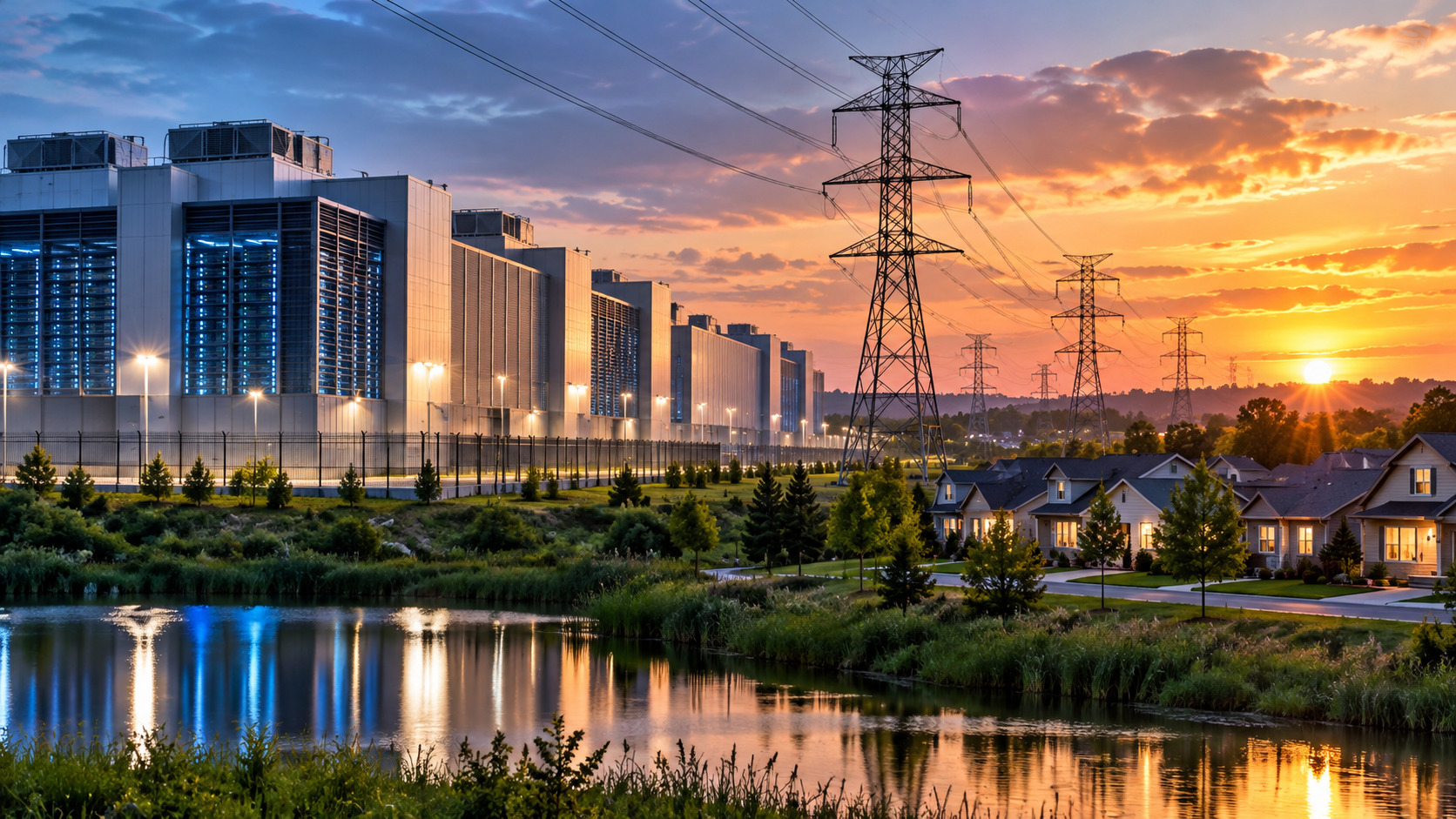
The Great Data Center Debate: Economic Growth, Artificial Intelligence, and the Cost to Our Communities
Data centers are powering our digital future, but are communities paying too high a price for technological progress?
Every time we search the internet, stream a movie, send an email, conduct an online transaction, or ask artificial intelligence (AI) a question, there is a good chance a data center is working behind the scenes.
These massive facilities house the servers, networking equipment, and storage systems that keep our increasingly connected world operating. They are essential infrastructure for modern businesses, cloud computing, online services, and the rapidly expanding artificial intelligence industry.
However, as technology companies invest billions of dollars in new data centers, a growing debate is taking place across the United States.
Are data centers an economic opportunity that communities should welcome, or are they becoming an expensive burden on local infrastructure, natural resources, and taxpayers?
The answer is not as simple as either side would like us to believe.
Why Are So Many Data Centers Being Built?
Data centers are not new. Businesses and technology companies have relied on them for decades. What has changed is the extraordinary demand for computing power.
Artificial intelligence is a major driver of this expansion. AI applications require powerful processors, enormous amounts of data storage, and substantial electricity to train and operate sophisticated models.
Cloud computing is another important factor. Rather than maintaining their own servers, businesses increasingly depend on providers such as Microsoft, Amazon, and Google to host applications, websites, databases, and business systems.
Other factors include:
- Increased use of streaming services and digital entertainment.
- Growth in online shopping and financial transactions.
- Greater demand for cloud-based business applications.
- Expansion of cybersecurity, backup, and disaster recovery services.
- Continued development of AI-powered business tools.
The demand for digital infrastructure is real, and data centers play an essential role in supporting it.
But just because something is necessary does not mean every proposed location is appropriate.
The Economic Argument: Jobs, Investment, and Tax Revenue
Supporters of data center development point to several potential economic benefits.
Major Capital Investment
A large data center campus can represent billions of dollars in private investment. Construction creates opportunities for electricians, plumbers, engineers, equipment suppliers, contractors, and other skilled workers.
Communities may also benefit from improvements to roads, electrical infrastructure, and other utilities, depending on how those improvements are funded.
Additional Tax Revenue
Data centers can generate substantial property tax revenue for local governments and school districts, particularly when development agreements do not significantly reduce those payments.
For communities seeking to expand their tax base, a large commercial development can appear very attractive.
Technology Infrastructure
Data center development may encourage additional investment in telecommunications networks, electrical systems, and supporting infrastructure.
That infrastructure could benefit surrounding businesses and potentially attract additional technology-related investment.
However, these benefits are not guaranteed. They depend on the specific project, tax agreements, infrastructure arrangements, and long-term economic conditions.
The Other Side: What Does a Data Center Really Cost?
While the economic benefits receive considerable attention, opponents raise legitimate concerns that deserve serious consideration.
- Electricity Consumption
One of the biggest concerns is the enormous amount of electricity required to operate large data centers.
Servers consume electricity continuously, and cooling systems require additional energy to keep equipment operating safely.
Unlike many commercial businesses, data centers typically operate 24 hours a day, seven days a week.
The rapid expansion of AI computing has increased concerns about whether existing electrical grids can accommodate this additional demand.
This raises several important questions:
- Will utilities need to construct additional power plants or transmission lines?
- Who will pay for those infrastructure improvements?
- Could residential and small-business electricity rates increase?
- Will additional demand delay the retirement of older power plants?
- Can renewable energy and other generation sources expand quickly enough?
The critical issue is not simply how much electricity a data center consumes. It is who pays for the infrastructure needed to supply that electricity.
If a private development creates substantial new utility costs, residents and existing businesses deserve to know whether those costs will be passed along to them.
- Water Consumption
Water usage is another major point of controversy.
Some data centers use water-intensive cooling systems to remove heat generated by servers. Depending on their cooling technology, climate, and operating practices, large facilities can require substantial amounts of water.
Other facilities use closed-loop systems, air cooling, or alternative technologies that significantly reduce direct water consumption.
This distinction matters because not all data centers have the same environmental footprint.
Communities should require developers to disclose projected water consumption, identify the water source, and explain how usage could change as computing capacity expands.
In areas facing water shortages or limitations on municipal infrastructure, these questions become especially important.
- Jobs: Construction Versus Long-Term Employment
Economic development announcements often emphasize the number of jobs a project will create.
But there is an important distinction between temporary construction employment and permanent jobs.
A large data center may employ hundreds or thousands of workers during construction. Once operational, however, highly automated facilities can require relatively small permanent staffs compared with manufacturing plants or other developments occupying similar amounts of land.
That does not mean the jobs are unimportant. Many are skilled, well-paying technical positions.
But communities should evaluate projects based on realistic long-term employment numbers rather than construction figures alone.
A billion-dollar investment does not automatically translate into thousands of permanent local jobs.
- Land Use and Community Character
Data centers can occupy hundreds of acres, especially when developed as large campuses.
Residents may be concerned about:
- Loss of farmland or open space.
- Large industrial-looking buildings near residential neighborhoods.
- Noise from cooling equipment and backup generators.
- Construction traffic and road deterioration.
- Changes to zoning and community development plans.
- Potential impacts on nearby property values.
Some concerns can be addressed through thoughtful site selection, landscaping, noise controls, and infrastructure planning.
Others may make a particular location unsuitable.
Local governments should consider whether a proposed data center is the best long-term use of valuable land, particularly when other forms of development could provide more jobs or community benefits.
Are Taxpayers Subsidizing Big Technology Companies?
Perhaps one of the most controversial issues involves financial incentives.
State and local governments sometimes offer tax exemptions, abatements, infrastructure assistance, or other incentives to attract data center investment.
Supporters argue that these incentives help communities compete for major development projects.
Critics question whether some of the world’s wealthiest technology companies need public financial assistance to build infrastructure essential to their own business models.
Both perspectives deserve consideration.
A development incentive may be justified when measurable public benefits exceed its costs. But incentives should not be approved without a transparent financial analysis.
Local officials should ask:
Would the company build the facility without the incentive?
If the answer is yes, taxpayers may be providing a subsidy without receiving meaningful additional benefits.
Any incentive package should include public disclosure, measurable commitments, and provisions protecting taxpayers if promised benefits fail to materialize.
The Environmental Question: Can Data Centers Become More Sustainable?
Technology companies frequently announce commitments to renewable energy, improved efficiency, and reduced environmental impact.
Those commitments are encouraging, but communities should examine actual operating practices rather than relying exclusively on corporate sustainability statements.
Important considerations include energy efficiency, cooling technology, carbon emissions, water usage, and the source of electricity.
For example, purchasing renewable energy credits does not necessarily mean a facility is powered by carbon-free electricity every hour of the day.
Likewise, a data center designed to use less water may require additional electricity for cooling, depending on the technology employed.
There are trade-offs involved.
The objective should be to evaluate the complete environmental impact rather than focusing on a single favorable statistic.
What About Wisconsin and the Midwest?
The Midwest has become an attractive region for data center development because of available land, established transportation networks, telecommunications infrastructure, and access to major population and business centers.
Wisconsin communities, including those in southeastern Wisconsin, are increasingly confronting questions about large technology infrastructure projects.
These discussions are particularly relevant in areas where agricultural land, residential neighborhoods, industrial development, and expanding electrical infrastructure compete for space.
Local officials face difficult decisions.
Welcoming investment can support economic development, but approving projects without fully understanding their long-term consequences can create problems lasting decades.
Residents should have meaningful opportunities to review proposals, question developers, and understand the financial and environmental implications before major decisions are finalized.
Small Businesses Have a Stake in This Debate, Too
The data center debate is not just about technology companies and local governments.
Small businesses have a direct interest in the outcome.
Most modern businesses depend on data center infrastructure, even if they never think about it.
Their websites, email systems, customer databases, accounting software, payment processing, and cloud applications rely on remote computing facilities.
Without data centers, many of the technology services small businesses use every day would be unavailable or considerably more expensive.
At the same time, small businesses are sensitive to operating costs.
If expanding data center demand contributes to higher electricity rates, local taxes, or infrastructure expenses, smaller companies may have fewer resources to absorb those increases.
This creates an interesting contradiction.
Small businesses need the technology that data centers provide, but they also need affordable utilities and responsible economic development.
The challenge is finding a balance that supports both objectives.
What Should Communities Demand Before Approving a Data Center?
Rather than automatically supporting or opposing every project, communities should insist on transparency and accountability.
Before approving a major development, local officials should obtain clear answers to several questions:
- Electricity: How much power will the facility require, and who pays for necessary grid improvements?
- Water: How much water will be consumed, and what cooling systems will be used?
- Employment: How many permanent jobs will be created, and what will those jobs pay?
- Taxes: What revenue will the project generate after accounting for exemptions and incentives?
- Infrastructure: Who pays for road improvements, utility upgrades, and other public services?
- Environmental impact: What safeguards will address noise, emissions, water usage, and neighboring properties?
- Accountability: What happens if the developer fails to meet its commitments?
These questions should be answered publicly, with supporting documentation, before elected officials make binding commitments.
Artificial Intelligence Is Changing the Equation
Artificial intelligence makes this debate particularly challenging because its future infrastructure requirements remain uncertain.
AI is already improving productivity, assisting with software development, supporting medical research, automating business processes, and creating new commercial opportunities.
Its potential is significant.
But technological progress does not eliminate the need for responsible planning.
More powerful AI systems may require additional computing infrastructure, although improvements in hardware, software efficiency, and model design could change future requirements.
Communities should be cautious about accepting long-term projections as guaranteed outcomes.
The technology industry evolves rapidly. A facility designed around today’s computing requirements may need significant upgrades or changes over its operating life.
That uncertainty should be reflected in development agreements and infrastructure planning.
The Bottom Line: We Need Data Centers, but We Also Need Common Sense
The debate over data centers should not become a simple argument between people who support technology and people who oppose it.
We need data centers. They support essential services, enable business growth, and provide the computing power required for continued technological innovation.
But communities are justified in questioning the costs.
Economic development should not mean writing a blank check to private corporations. Nor should legitimate concerns about electricity, water, taxes, and land use be dismissed as opposition to progress.
The best projects will be those that demonstrate clear economic benefits, responsible resource consumption, transparent financial arrangements, and meaningful protections for surrounding communities.
Local governments have an obligation to evaluate these proposals carefully, and technology companies have a responsibility to be transparent about their needs and impacts.
Technological advancement and community responsibility should not be competing priorities. They should go hand in hand.
The question is not whether America needs more data centers.
The question is whether we are building them in the right places, under the right conditions, and with the right protections for the people who will live with the consequences.
What Do You Think?
Would you welcome a major data center development in your community if it promised substantial investment and additional tax revenue?
Or would concerns about electricity costs, water consumption, and long-term community impact make you hesitant?
The debate is far from over, and it is one that every business owner, taxpayer, and community leader should be paying attention to.
About Horner Consulting & Publishing LLC
Since 1999, Horner Consulting & Publishing LLC has helped businesses and organizations navigate technology, website development, digital communications, and business challenges.
Technology continues to change how we work and conduct business. Understanding both its opportunities and its costs is essential to making informed decisions.
Your Source for Custom Business and Technology Solutions.